Every card you own. What you paid, what it's worth.
Photograph a card and Raw to Slab reads the set line, the card number, even the parallel. Every card gets a value from real completed sales, never asking prices, so your whole collection adds up in one place: what you paid against what it's worth today, raw or graded. Built by a collector who got tired of guessing.
Raw to Slab is a free-to-start web app for sports card collectors: photograph a card and it is identified, valued from real completed sales, and tracked against what you paid.
Create a free account Try the free grading calculator
Not ready for an account? Work out if a card is worth grading (free calculator, no signup).
Everything between the card and the slab
Snap it, know it
Photograph a raw card, front and back. The AI reads the set line, card number, parallel, even the serial. No barcode, no typing.
Priced from real sales
Values come from actual sold listings: filtered, matched to your exact parallel and grade, and weighted toward recent sales. Never from asking prices.
Raw → graded ladder
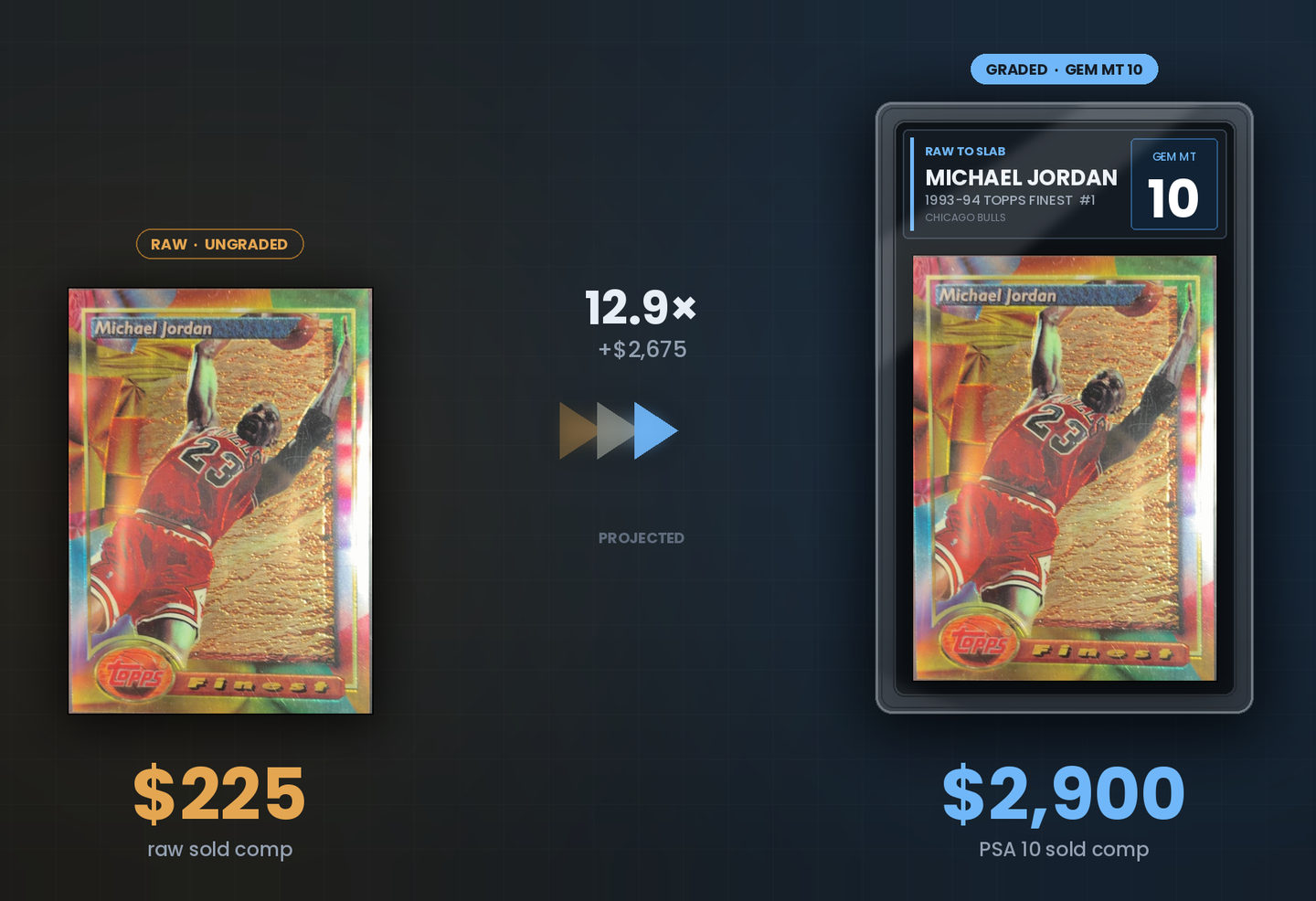
See what your raw card is worth today and what it sells for slabbed at every PSA grade its era actually trades, plus BGS 9.5 and SGC 10, so you know if grading is worth the fee before you ship it.
A panel that checks its work
Cards the market can't price get a nightly review from a three-member AI panel. Fixes are proposed with evidence, and you accept them with one tap.
List where you priced
Connect your own eBay seller account and turn a card into an auction or Buy-It-Now without leaving the app. Countdown timers, fee-aware profit, monthly P&L. Running a Whatnot show instead? Tick the cards and download the file their bulk importer reads. Both channels are the top plan's; the plans under it identify, price and track cards, and export them as a CSV that is yours.
Watch cards you don't own yet
A watchlist with the same honest comps, price-history charts, and move alerts, so you buy the dip on the card you've been circling.
A weekly pulse, not spam
One digest email a week: collection value, movers, what needs a look. Opt-in, one-click unsubscribe, and price alerts only when a real move clears the noise gates.
Your cards, your data
Installs like an app straight from the browser, with no app store. Export everything as JSON any time, or delete your account and all of it, permanently, yourself.
The number you can defend at the table
Most pricing tools hand you a number no matter what, built from asking prices, index averages, or whatever sold listing was nearest. Raw to Slab.ai would rather tell you “not enough data” than flatter you with a made-up value:
Won't price from one sale
One sale is an anecdote, and it is never enough to call a value dependable. That takes a pool of recent matched sales. Thinner than that you get “not enough data”: the app names what is wrong with the pool and stops showing a number, never a confident guess.
Rejects contaminated comps
Sellers stuff “Silver Prizm” into base-card titles. The engine catches mislabeled sales, mixed lots, and reprints before they touch your number.
Distrusts weird spreads
When the matched sales disagree wildly, that's two different cards in one pool, and the engine refuses to average them into fiction.
Shows its work
Every value links to the sold listings behind it. Tap through and check the comps yourself. Skepticism is a feature.
Who this isn't for
If your cards are 1990 Donruss commons, we'll tell you what the market tells you: they're worth less than the postage to ship them. Raw to Slab is built for the card where the grading fee is a real decision, roughly $50 and up raw, and it earns its keep above $200. Below that the honest answer is always no, and you don't need an app to hear it.
Meet the review panel
When a card stumps the market, with no value or a doubtful ID, it goes in front of a panel of three AI specialists overnight. They argue it out, and you wake up to proposed fixes with the evidence attached.
Sonny “Rip” Kovac, The Collector
Ripping wax since the junk-wax era. Sonny knows every set line, insert run, and parallel finish by sight, and reads the card number off the BACK, never the jersey number. When your card's identity is off by one word, Sonny is the one who catches it.
Grace Liang, The Grader
A professional grader's eye for slabs: labels, cert numbers, centering, surface. Grace keeps raw cards from being priced as slabs and PSA 9s from being priced as 10s, the mix-ups that swing a valuation 10x.
“Doc” Ochoa, The Data Scientist
Doc builds the evidence pack: the comp pool, which sales made the cut, and why the near-misses were rejected, whether reprints, lots, or stuffed titles. If the data is too thin to trust, Doc says so instead of making a number up.
Sonny, Grace, and Doc are AI reviewers, personas of the same panel prompt, each holding the others honest. Their proposals are suggestions with evidence, never silent edits.
Questions collectors ask
Where do the card values come from?
From real sold listings matched to your exact card, parallel, and grading state, never from asking prices. One sale is an anecdote and is never enough to call a value dependable: that takes a pool of recent matched sales, the market the card is trading in now rather than a year of it. When the pool is too thin, too old or too scattered, the app says which, and it stops showing a number rather than inventing one. Your own typed estimate always stays.
Does it work for graded cards or only raw?
Both. Raw cards additionally get a graded-value ladder: what the same card sells for at each grade its era actually trades, PSA 3 up to PSA 10 depending on the card, plus BGS 9.5 and SGC 10, so you can judge whether grading is worth the fee. A card already in a slab finds its own grade on that ladder.
Which cards and sports does it cover?
Sports cards. Baseball, basketball, football, hockey, soccer, golf, racing and wrestling are what the identification and the comp matching are actually built for. Inside those, coverage is set by whether real sold comps exist rather than by a fixed list of sets, and a card too thinly traded to price honestly gets “not enough data” instead of a guessed number. Pokémon and other TCG are not supported yet: you can store the cards, but nothing in the matcher speaks TCG vocabulary, so most of them will not find comps. It is on the roadmap, not in the product.
Is this worth using for a shoebox of old cards?
Probably not, and we'd rather say so. A late-80s or early-90s common is worth less than the postage, and no grade changes that: the fee alone is more than the card. Raw to Slab.ai earns its keep on the card where grading is a real decision, roughly $50 and up raw. You can check one for free either way, and it will tell you the same thing.
How is this different from card scanner apps?
Most scanners price from asking prices or index averages. Raw to Slab.ai prices only from sold comps, filters out contaminated sales like title-stuffed parallels and mixed lots, links every value to the sales behind it, and refuses to price thin data. You can see the approach before signing up: the free grading calculator at /grading-calculator shows the lowest grade at which grading beats selling raw, no account needed.
Can I sell my cards through it?
Yes, in two places, and both of them are the top plan's. Listing to eBay from the app: connect your own eBay seller account and create auctions or Buy-It-Now listings, with fee-aware profit tracking and monthly P&L. Running a Whatnot show: tick the cards you are taking on stream and download them as the CSV Whatnot's bulk importer reads, with the title, the category, the condition, the price and the photo links already filled in. Exporting your own inventory as a CSV is a different thing and stays on every plan, free included. The pricing page is where the plans are set out.
Do I have to sell, or can I just track a collection?
Just track it if you like. Collector mode puts collection value and cost-basis analytics front and centre: what you paid versus what it’s worth, with realized and unrealized profit. It keeps the selling tools out of the way until you want them. Listing on eBay is always optional, never required, and it lives on the top plan, so a collector who never sells never pays for it.
Is it free?
There is a real free account and it needs no credit card: a username and a password, and it installs from the browser as a web app on iPhone, Android, or desktop. Free holds a fixed-size collection and a monthly allowance of AI scans, with sold-comp values and grade ladders on every card you add, and your data stays exportable and deletable whatever you pay. It is not unlimited. Paid plans lift the card limit entirely, raise the scan allowance and add what free does not include: values that keep refreshing as the market moves and the watchlist. Listing to eBay sits a step further up again, on the top plan alone. The pricing page is the one place the limits and the prices are written down.
Card values are estimates from public sold-listing data, not appraisals, offers, or investment advice.